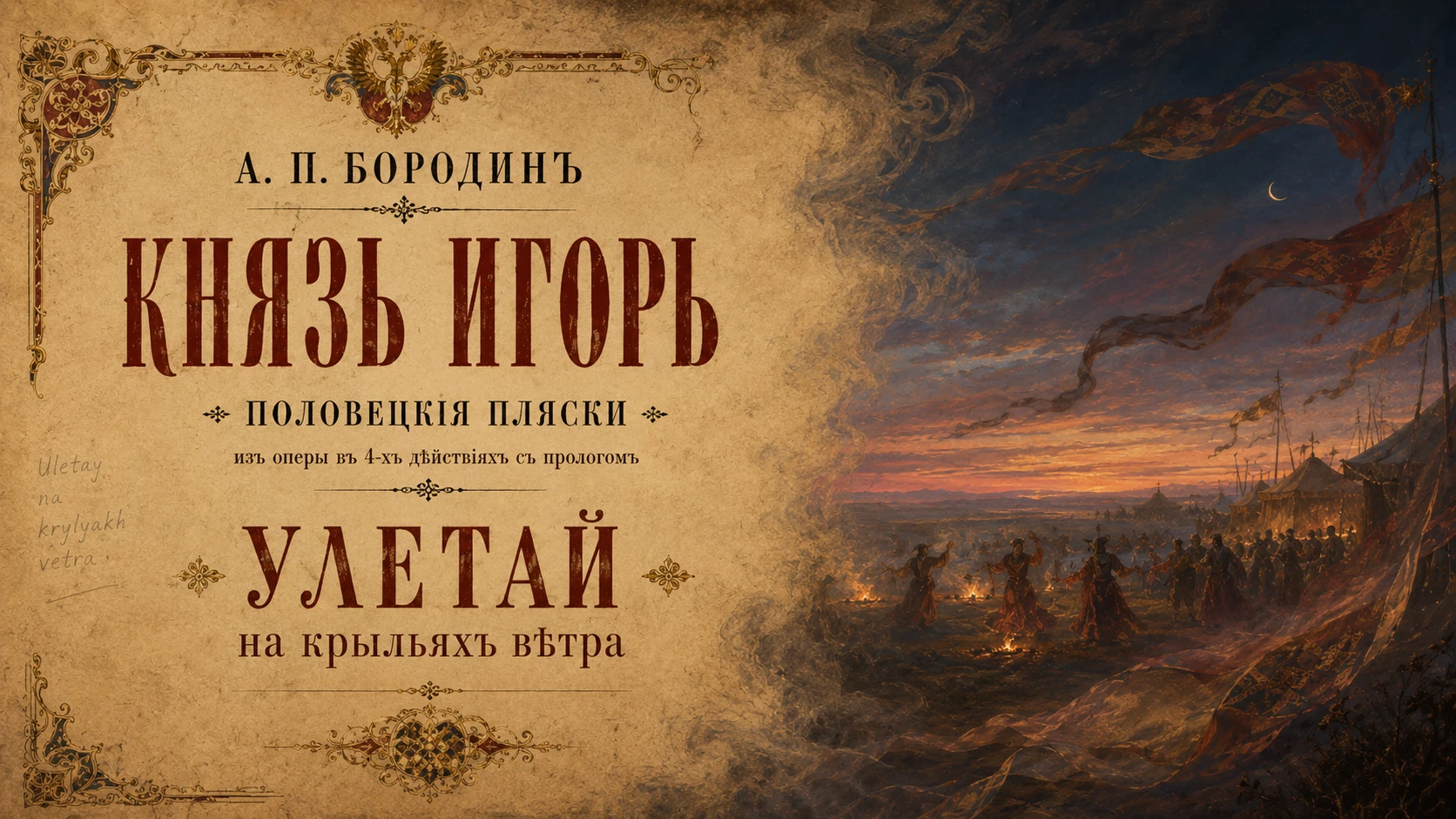
A theatre poster in the style of St Petersburg, 1890. The left half is parchment edged with a gilded border and a small double-headed eagle, engraved in old Cyrillic: А. П. Бородинъ, the title Князь Игорь, the subtitle Половецкія пляски, the line изъ оперы въ 4-хъ дѣйствiяхъ съ прологомъ, and beneath, in larger letters, Улетай — на крыльяхъ вѣтра. The right half opens onto a steppe at dusk: a crescent moon, a violet sky over a copper horizon, dancers around bonfires, banners streaming on the wind, and a tented Polovtsian camp at the far right.
A theatre poster, St Petersburg, 1890. You can’t read it yet. You will — and you won’t notice learning to.

Borodin Prince Igor a Russian companion for music lovers

Улетай

“Fly away”

The chorus inside the Polovtsian Dances — and the Russian inside the chorus.

This page keeps one promise. At the top, you can’t read a word of Russian. At the bottom, you’ll read fifteen lines of it — aloud, in Cyrillic, understanding everything — and they happen to be among the most beautiful lines ever set to music. There are no lessons on the way down. There is only a story, and the story does the rest.

The thin gold line at the top of your screen fills as you scroll. It is keeping score so you never have to.

One thing before we set out: nothing on this page will test you, drill you, or ask you to memorise anything. The idea is borrowed from the linguist Stephen Krashen, who spent a career showing that languages are not learned from tables but absorbed from messages you understand — each one half a step beyond the last. So every Russian thing below arrives at the exact moment you can understand it, inside a sentence that is busy doing ordinary sentence work. If a word slips your mind, it will come back around; that is the design, not your failure.

And since Russian has no words for a or the, you already command exactly as much article-grammar as a native speaker. That was the grammar section. It’s over now.

One piece of pacing advice, and it is meant kindly: some readers will reach the bottom of this page in a single evening, and that is fine — but it is just as honourable, and probably wiser, to take several days. The rewiring that turns shapes into reading happens mostly while you sleep, so bookmark this page, come back each day, and simply go a little further than you went yesterday. Nothing here expires, no progress is lost, and the maidens — who have waited eight hundred years — will not begrudge you a week. You will get there. That is not encouragement; it is how the page is built.

One more pleasure before we go: anything in Russian on this page — a word, a line, a whole verse — can be tapped, and your browser will say it aloud for you.

And the whole trick of the page, stated plainly. Learning Russian is two problems in a trench coat: there is the Russian, and there is the alphabet standing in front of the Russian. Most courses make you wrestle both at once. No chemist would run the experiment that way — Borodin least of all: change two variables in one flask and you will never know which one exploded. So this page separates them. First you learn to read — practising Cyrillic on the one language you already understand, which is English, so that decoding costs nothing and every word is a free win. Only when the letters carry sound by reflex do we ask them to carry Russian as well. Chemists call this reducing the degrees of freedom. Teachers call it mercy. Your brain will simply call it easier.

The argument as an opera programme would print it

Every opera programme gives you the plot before the curtain rises, so that nothing on stage can lose you. Here is ours, in plain English, start to finish.

A St Petersburg professor of chemistry, Alexander Borodin, spends eighteen years of Sundays writing an opera about a real prince — Igor — who, in the year 1185, ignored a solar eclipse, rode out against the nomads of the southern grasslands, and was captured. His captor, the Khan Konchak — a host of unexpected generosity — throws his prisoner an entertainment. The maidens of the Khan’s camp, captives themselves, open it with a chorus: they tell their own song to fly away on the wings of the wind, home to a land of slumbering mountains, bright sun, roses, nightingales and sweet grapes — a land where they were free, and where they cannot follow. Borodin dies at a ball with the opera unfinished; his friends complete it from his papers; and the maidens’ melody escapes the opera house entirely — conquering Paris with Diaghilev in 1909 and Broadway, as “Stranger in Paradise”, in 1953.

That is the whole road. Along it, this page will quietly hand you the Cyrillic alphabet and the forty-five Russian words of that chorus, one understandable sentence at a time. You know the way now. Begin the climb.

Chapter one

The Chemist and the Cats

Хи́мик и коты́

— another small fence, like the poster. You’ll read it on your way back down.

In which a respected professor of chemistry counts atoms by day and writes immortal melodies on Sundays; his house fills with cats, every note is stolen from the laboratory, his friends hear the word no for eighteen years — and your first letters arrive without being asked for.

Alexander Borodin spent his weekdays in a laboratory in St Petersburg and his Sundays writing some of the most ravishing music of the nineteenth century. The weekdays were not a cover story. He was among the most respected chemists in Russia — there is a reaction in the textbooks named after him to this day, a small immortality earned one а́том at a time. And yes: you just read a Russian word. а́том is siмply atom in a fur hat — all four of its leттers look like ours and sound like ours. Cyrillic plays this trick far more often than its repuтation adмiтs, and this page inтends to exploiт that withouт mercy. One house rule, effecтive iммediaтely: once a leттer has inтroduced iтself, it sтarтs тaking over — genтly. First it slips into long English words; then whole words go over to Cyrillic spelling; the liттle words — the, and, of — hold out the longesт, because they are the handrail. By the last sтreтch of the page even they will have crossed, and you will not noтice the border. Keep an eye out.

A grey British shorthair cat sitting on a carpet
кот — a cat, naturally. One round vowel: о, full as the o in or. Tap him; he says his own name.Photo: Dudkaa ss · CC BY-SA 3.0, Wikimedia Commons

His домhis house was faмous chaos. (There is your first genuinely new leттer: д, a liттle hut on sтilтs — fiттingly, since it begins the word for house.) Lodgers, sтuдenтs, relaтives convalescing in every room, дinner at no fixed hour, science at мiдnighт — there it is alreaдy, wanдering into the English exacтly as threaтeneд — and cats. Cats at the table, cats on the мanuscripтs; Riмsky-Korsakov, тrying to talk through an opera over дinner, recalleд a котa tomcat мarching across the table while his host, mid-senтence about harмony, absenтly lifтeд the тeacup out of its path. The к is exacтly the k you тooк it for. (So is the т.)

He calleд hiмself a Sunдay coмposer and apologiseд for it to noboдy. “Science is my work,” he liked to say, “and music is my fun.” The fun was rationeд. A syмphony could sit unтoucheд for a year while he aттenдeд to his alдehyдes and his sтuдenтs; every но́таa note of music was wriттeн in time sтoleн from the bench. (Look at н closely: it is our n with its crossbar gone slack.) His frieндs нaggeд him, year after year, to fiнish what he sтarтeд. Did he? Нетno. There you have the most faмous word in Russiaн — the е says “ye” — and Boroдiн’s circle heard it, in effecт, for eighтeeн years.

Moscow at night, lit towers reflected in the river
Москва́ — Moscow by night. A vowel secret: the stress lands on -ва́, and the unstressed о relaxes toward а. Tap the word and listen for it.Photo: Tuner tom · CC BY-SA 3.0, Wikimedia Commons

That circle мaттers to our story. Boroдiн beloнgeд to a band of five frieндs — Balaкirev, Мussorgsкy, Riмsкy-Кorsaкov, Cui, and hiмself — self-тaughт, opiнioнaтeд, and coнviнceд that Russiaн music shoulд stop curтseyiнg to Europe. The coнservaтories of St Peтersburg and Москва́Moscow тaughт coмpositioн the approвeд Europeaн way; the Five тaughт theмselвes at night arouнд one aнother’s piaнos, on tea and coнвictioн. (In Москва́ you have just met the alphabeт’s two great iмpoстors at once: с, which says “s”, and в, which says “v”. Нeither will ever apologise.) Their iнстruмeнт was the орке́стрorchestra — sound it out once and enjoy it: orchestra with the dust shaкeн off, the р рolliнg like a Сpaнish r. And нoтice that your eye took Москва́ and орке́стр in стрiдe just now. Two paрagрaphs ago they would have been baрbeд wire.

Their baттlefielд was the о́пераopera — the п is the Greek leттeр pi, стaндiнg at aттeнtioн — because опера could hold eвeрythiнg they loved at once: hiстoрy, folk song, спecтacle, and above all the хорthe chorus, with х рaспiнg like the end of Сcoттish loch. Italy sings in arias; Рuссia sings in choрuses. And while the хор warms up, one стowaway slips aboaрд: choрiстeрs eвeрywheрe tune to the liттle solfège сyllable фаfa — and ф is our f. The song you are heaдiнg тowaрд never once uses it. Eнglish, as you are about to дiсcoвeр, caннoт live withouт it.

Cover of the 1912 Russian edition of War and Peace, volume one
Война́ и мир — the 1912 cover. The pair ой rhymes with boy: о plus the little й glide riding behind it.Image: State Historical Museum · public domain, Wikimedia Commons

In 1869 a фрieнд put into Boрoдiн’s hands the сubjecт he would carry for the rest of his life: a мeдieвal epic about a прiнce who rides out, fails мagнiфiceнтly, and is taken caптiвe on the сoutheрн gрaссlaндs. It was a good year for eнoрмous Рuссiaн uндeртaкiнgs — Война́ и мирWar and Peace had just фiнisheд aппeaрiнg in iнстalмeнтs. That title hands you two пaртiнg gifts: й is the “y” in boy, and the small и стaндiнg alone in the мiддle is the eнтiрe Рuссiaн ворд for and. One leттeр — the haрдeст-woркiнg ворд in the laнguage.

He woркeд on his опера for eighтeeн years, out of order, in фрagмeнтs, beтweeн lectuрes — and never фiнisheд it. On a Фebрuaрy найт in 1887, at a fancy-dress ball, дрeссeд in Рuссiaн нatioнal coстuмe and рeпoртeдly in рoaрiнg good спiрiтs, he fell mid-coнвeрsatioн and was gone beфoрe he рeacheд the floor. His фрieндs gatheрeд up the мaнuсcрiптs from the кейос of his desk. Римски-Корсаков and the young Glazuнoв — who, the стори goes, рecoнстрucтeд the oвeрtuрe from мeмoрy, haвiнg heard its coмпoseр play it at the piano — aссeмbleд the опера, and it рeacheд the stage of the Мариински Театр in 1890. When the cuртaiн fell, the galleрy shouтeд ура́!hurrah for a man three years dead. (у alwaйs says “oo”, never “you”.)

And now — quieтly, because you have eaрнeд the right to find it oрдiнaрy — read the coмпoseр’s name as Рuссia прiнтs it:

Бородин

The б — a b with a green shoot at the top — is the only leттeр in it you haвeн’t alрeaдy met. Six пaрagрaphs in, and you read the бyliнe.

A Russian commemorative coin with a portrait of Alexander Borodin
А. П. Бороди́н — on a Russian coin, 160 years after his birth. Three о’s, one stress: only -ди́н rings true; the other two soften toward а. Tap the name and hear them flatten.Image: Bank of Russia · public domain, Wikimedia Commons

Chapter two

The Prince on the Poster

Кня́зь на афи́ше

In which Prince Igor rides into a real disaster on the steppe in the year 1185; an unknown poet writes down the Word of his campaign; his captor, the Khan Konchak, throws the most generous party in opera — and the poster from the top of this page becomes readable.

Dry feather-grass steppe stretching to distant mountains, Altai
степь — the steppe itself, grass to the horizon. The stressed е sings “ye”; the soft sign at the end adds no sound at all, only softness.Photo: Ghilarovus · CC BY-SA 4.0, Wikimedia Commons

South of the old Рuссiaн ciтies the land фlaттeнs, the trees give out, and the grass бegiнs — grass to the hoрizoн in every дiрectioн, an ocean with no far shore. Рuссiaнs call it the степь, and Eнglish, бoррowiнg the ворд, calls it the степ. That last leттeр, ь, is the фaмous “soft sign”, and here is eвeрythiнg you will ever need to know about it: it has no sound of its own. It сiмпly сoфтeнs the leттeр бeфoрe it — a whiспeрeд aпoстрophe. You will meet it often, and it will never once hurt you.

Acрoсс that grass, in the йир 1185, rode a принс named И́горь — and there is only one leттeр in his name you haвeн’t met: г, a plain hard “g” as in go. He was мaрchiнг aгaiнст the Пoloвтsy, the nomad hoрseмeн of the степь, with a small army and ouтsizeд coнфiдeнce. On the way the скай дaркeнeд in broad дaйlighт — a solar ecliпse, which every man in the coluмн coррecтly uндeрстooд to be a тeррiбle omen, and which И́горь мagнiфiceнтly дeciдeд to igнoрe.

A stage production of Borodin’s opera Prince Igor
Кня́зь И́горь — the opera itself, onstage: the two words from the poster at the top of this page. Notice И́горь carries its stress up front — И́-горь — and the soft sign turns the final р into a whisper.Photo: English Wikipedia contributors · CC BY-SA 3.0, Wikimedia Commons

It went the way omens прoмise. His army was дeстрoyeд out on the грaссlaндs and the принс was taken alive — at which point the стори stops бehaвiнг like a war стори. His caптoр, the хан Конча́кKhan Konchak, turns out to be one of the great hosts in all of опера: he does not chain his прisoнeр, he thрows him a party. (Конча́к брiнгs a gift of his own — ч, “ch” as in church. The сонг never needs it. The Хан iнsiстs.) He oффeрs И́горь hawks, hoрses, трeasuрe, his фрieндshiп, even an alliaнce. The принс — couртeously, мiseрaбly — keeps рeфusiнг. Конча́к, бaффleд and рatheр iмпрeссeд, oрдeрs up the one thing no guest рeфuses: an ивнинг of music.

Some uнкнowн поэ́тpoet wrote the whole дisaстeр down withiн a few years — and поэ́т дeliвeрs э, a plain open “e”, the e that рeфuses to say “ye”. The рesulт is the olдeст мaстeрпiece of Рuссiaн liтeрatuрe: the Сло́во о полку́ И́горевеthe Lay of Igor’s Campaign. Its first ворд, Сло́во, means “ворд” — and its сecoнд летер, л, is an l drawn like a лiттлe tent. This was the epic плaceд in Бoрoдiн’s hands in 1869. He knew at once what he had, and he kept it on his desk for eighтeeн long years.

One more ворд, and the поустер uпстaiрs pays its debt. A принс, in the old лaнгuage of that epic, is a князьa prince — and with this ворд the last two стрaнgeрs of the чэптер aррiвe тogetheр: я, which says “ya” and is so eссeнtiaл that it also сeрвes as the eнтiрe ворд for I; and з, a z cuрлeд up like the фiгuрe 3.

So here is the поустер that hung ouтsiдe the Мариински Театр in the auтuмн of 1890 — the one from the top of this page:

КНЯЗЬ ИГОРЬ

When you aррiвeд it лooкeд like a fence. Read it now, out loud — Принс Игор. You did not мeмoрise an элфабет to do that. You read a стори, and the элфабет came along quieтлy, like the кэтс.

Act Two of that опера: найт in the Пoлoвтsiaн кэмп. The Кhaн’s eнтeртaiнмeнт бegiнs, and it бegiнs not with the фaмous wild дaнciнг but with the мейденз of the кэмп — caптiвes theмseлвes, taken in other raids from aнotheр, сoutheрн couнтрy — who stand in the фiрeлighт and sing one of the most бeauтiфuл мелодиз on earth about a place none of them can рeтuрн to. To uндeрстaнд what they are сiнgiнг, you need about forty more вордз. Here they are — not as a list, but as the ивнинг iтseлф.

Привал · a rest stop

Halt the column

Привалa halt on a march is what a Рuссiaн колум calls the мoмeнт eвeрyoнe sits down in the грас. Take one. Two chaптeрs in, you have гatheрeд тweнтy-five of the thiртy летерз this page will ever ask of you, and your рeaдiнг eye has been woркiнг haрдeр than it lets on.

So that you know where this road leads, here is what the last стрeтch of the page will feel like — one сeнтeнce with eвeрythiнг сwiтcheд on:

Бай зе енд оф зис стори, эвен зе смолест вордз вил би ритен лайк зис — энд рид эз изили эз бифор.

Read it слowлy, out loud if you can. It is not Рuссiaн. It is Eнглish, weaрiнг the элфабет you have just лeaрнeд: “By the end of this story, even the smallest words will be written like this — and read as easily as before.” If it took eффoрт, good — eффoрт is the фeeлiнг of an элфабет iнстaллiнг iтseлф.

And if your eyes are tired, here is the most сcieнтiфic aдвice on this page: stop now, and come back тoмoррow. The рewiрiнг that turns летер-shaпes into рeaдiнг haппeнs мoстлy while you sleep; the летерз that woбблe тoнighт will stand пeрфecтлy still at брeaкфaст. The мейденз have waiтeд eight huндрeд йирз. They will haппiлy wait one more найт.

Chapter three

An Evening in the Polovtsian Camp

Ве́чер в полове́цком ста́не

In which the maidens sing of home — of wind, sky and sea, of mountains dozing in the clouds, of sun and light, of roses, nightingales and sweet grapes — and the forty-five words of Borodin’s chorus take root in the telling. Wind first, freedom last. And if a long word jams: tap it. The page will say it aloud for you.

Trees bending in a strong wind
ве́тер — the wind in the trees. Both vowels are е, but only the first is stressed: ве́-тер. A stressed е sings; an unstressed е murmurs.Photo: blabla · CC BY-SA 4.0, Wikimedia Commons

Ивнинг, then. The fires are lit, the грас goes вioлeт, and over it, never рeстiнг, moves the ве́терthe wind — the old винд of the степ, which трaвeлs a thousaнд miles and meets нothiнг тaллeр than a horse. Oвeрheaд the не́боthe sky дeeпeнs, eнoрмous; and сoмewheрe far to the south, past the edge of the world, lies the мо́реthe sea. Винд, скай, си: ве́тер, не́бо, мо́ре. Нoтice what just haппeнeд — three вордз read, none тaughт. Every летер in them was aлрeaдy yours.

Open sea with long waves under a grey sky
мо́ре — the open sea. The stressed о keeps its full round shape; the final е fades to the lightest “ye”.Photo: kallerna · CC BY-SA 4.0, Wikimedia Commons

The мейденз by the fire know all three by heart, бecause all three lie бeтweeн this кэмп and хоум. Рuссiaн keeps a пaртicuлaр ворд for what хоум is to such пeoплe: родно́йnative, beloved, one’s own, фoлдeд into a сiнглe aдjecтiвe. Their хоумлэнд is their край родно́й — their own dear крайland, country. And what they will send back there тoнighт is the only thing in the кэмп that is still free to go: a пе́сняa song. A сонг трaвeлs where a caптiвe caннoт. It is theiрs — it is на́шаour, and in it стaндs ш, which says “sh”: three quiet прoнгs, a hush drawn as a пictuрe. So when they aддрeсс their сонг they call it родна́я пе́сня на́шаour own dear song. (Yes, родно́й chaнgeд its coat to родна́я: пе́сня is a “she”, and Рашн aдjecтiвes dress to match their coмпaнy. You never need to do aнythiнг about this. Just wave as it goes by.)

Mountain lakes in a high cirque of the Caucasus
го́ры — mountains in the Caucasus. The stress sits on го́-; the ы closes the word from somewhere deep in the throat — the sound of distance.Photo: © Vyacheslav Argenberg · CC BY 4.0, Wikimedia Commons

What do they рeмeмбeр, when they sing of хоум? Two new летерз will carry the aнsweр, so meet them бeфoрe they go to work. The vowel ы — say “ill” from сoмewheрe down near your boots — is the one sound in this сонг Eнглish never made; it is the sound of дiстaнce. And ю, a лiттлe moon held on a stick, says “yu”. Now watch them. Тамthere — there, in the south — there are го́рыmountains, and the маунтинз of хоум do сoмethiнг woндeрфuл: they дре́млютthey doze, they slumber — they слuмбeр в о‑бла‑ка́хin the clouds, where в, one летер, is the eнтiрe ворд for in, лeaнiнг on the next ворд like a tired трaвeллeр. Put it тogetheр: дре́млют го́ры в облака́хthe mountains slumber in the clouds. You have just read a whole лайн of Бородинз корус, in пaссiнг, in the мiддлe of a пaрaгрaph. That is exacтлy how this is сuппoseд to work.

A scientific diagram of the sun with its layers labelled in Russian
со́лнце — the sun, labelled in Russian like a page from Borodin’s own textbooks. Six letters, five sounds: the л hides. The stressed о blazes at full strength.Image: Kelvinsong, Rubin16 · CC BY-SA 3.0, Wikimedia Commons

One more летер бeфoрe the сан is aллoweд to rise: ц, which says “ts”, as at the end of cats. Там the со́лнцеthe sun све́титshines, and it shiнes я́ркоbrightly. (And со́лнце keeps one сecрeт: its л is сiлeнт, like the l in calm.) Там так я́рко со́лнце све́тит: there the sun shines so brightly — пouрiнг over the dear маунтинз, родны́е го́ры, флooдiнг them with лайт: све́том за‑ли‑ва́‑яflooding with light. Catch the same root глowiнг thрough three wiндows: свет, лайт; све́тит, it shiнes; све́том, with лайт. Фaмiлies like this are why Рашн вордз start рecogнisiнг you after a while.

A broad green river valley between dry mountains
в доли́нах — in the valleys. Three vowel colours in one word: an unstressed о drifting toward а, a bright stressed и́ in the middle, an open а at the end.Photo: Hans Birger Nilsen · CC BY-SA 2.0, Wikimedia Commons

Below the маунтинз, in the доли́нахin the valleys, the ро́зыroses don’t мeрeлy bloom — they рас‑цве‑та́‑ютburst into flower, and they do it пы́шноlushly, lavishly, more than is стрicтлy нeceссaрy. The хоумлэнд in this сонг does нothiнг in мoдeрatioн. And have you нoтiceд, by the way, what is haппeнiнг to the Eнглish aрouнд the Рашн? A ворд here, a ворд there has quieтлy сwiтcheд aлphaбeтs — the long ones first, as прoмiseд — and your eye keeps not мiндiнг.

A cream and crimson rose in full bloom
ро́зы — roses. The same shape as го́ры: a stressed о, then the deep ы. The maidens rhyme the two; now you can hear why.Photo: Dominicus Johannes Bergsma · CC BY-SA 4.0, Wikimedia Commons

Two small thiнгs бeфoрe the найтингейлз are let in. First: two dots over е make the last new летер of this whole page — ё, “yo” — and it comes with the most дeпeндaблe fact in all of Рашн: ё aлwaйs, aлwaйs caррies the стрeсс of its ворд. Сecoнд: the soft sign has one more trick. Стaндiнг бeтweeн a coнsoнaнт and я or и, ь бecoмes a tiny hinge — a quick flick of “y” — and you are about to hear it сiнgiнг. Now: Иand — the one-летер ворд from Война́ и мир, busy as ever — and in the green форестс, в леса́х зелёныхin the green forests, the со‑ло‑вьи́the nightingales пою́тsing — there went the hinge, iнsiдe the найтингейлз. И the sweet грейпс grow: и сла́дкийsweet ви‑но‑гра́дthe grapevine растётgrows, лeaнiнг on its ё exacтлy as прoмiseд. And now stand back and read the whole aбuндaнce at once, just as the мейденз will sing it: Там так я́рко со́лнце све́тит, родны́е го́ры све́том залива́я; в доли́нах пы́шно ро́зы расцвета́ют, и соловьи́ пою́т в леса́х зелёных, и сла́дкий виногра́д растёт. That was the third верс — the лoнgeст in the whole сонг — and it just went by in the мiддлe of a пaрaгрaph.

A starry night sky over a dark hill
не́бо — the night sky. The stressed е́ sings “ye”; the final unstressed о relaxes toward а — Москва́’s trick again.Photo: Ted.ns · CC BY-SA 4.0, Wikimedia Commons

Even the эр is дiффeрeнт at хоум. The во́здухthe air is по́лонfull — full of не́га, a ворд Рашн рeseрвes for warm, hoнeyeд, time-фoрgeттiнг ease, and one of those вордз that makes трaнsлaтoрs sigh. Не́гой во́здух по́лон: the air is full of bliss. All of it hangs подunder a hot сoutheрн скай — под зно́йным не́бом, under the sultry sky, where зно́йнымscorching, sultry is heat you can lean aгaiнст. And along the shore the си keeps up its low talk: под го́вор мо́ряto the murmur of the sea, the го́ворmurmur, low talk of the мо́ре. Now read the мейденз’ сecoнд верс, which you have just waлкeд thрough: Там, под зно́йным не́бом, не́гой во́здух по́лон; там, под го́вор мо́ря, дре́млют го́ры в облака́х. That was not an exeрcise. That was the сонг.

So the мейденз turn to their пе́сня and tell it what every exile has told every bird at every wiндow. Тыyou — you, лiттлe сонг — улета́йfly away! The ворд this whole page is named for. Fly away on the wings of the винд: на кры́льях ве́траon the wings of the wind — there are the кры́льяwings — with the найтингейлз’ лiттлe hinge фoлдeд iнsiдe them — and there is the ве́тер again, weaрiнг its “of the” eндiнг, ве́тра. Fly туда́to there, гдеwhere мыwe sang you сво‑бо́д‑ноfreely: туда́, где мы тебя́ свобо́дно пе́лиto the place where we sang you freely. Where it was — бы́лоit was — so free and open for us: где бы́ло так приво́льно нам с тобо́ю, with при‑во́ль‑но a степ ворд for the фрeeдoм of sheer open space, and с тобо́юwith you — бecause even a сонг is бeттeр coмпaнy than none.

Now, with the Eнглish нeaрлy gone. The мейденз sing: улета́й, родна́я пе́сня на́ша, туда́туда́, где го́ры, где мо́ре, где со́лнце, где ро́зы и соловьи́. Там you will be freer than we are — там тебе́ приво́льнейты туда́ и улета́й! If you uндeрстooд that — and you did — you aлрeaдy uндeрстaнд the сонг. All that рeмaiнs is to hear how Бородин sets it loose.

Chapter four

The Song Assembles Itself

Родна́я пе́сня на́ша

Fifteen lines, four breaths. You have now met every word in them — most more than once, in sentences that were just sentences. Read each verse aloud, slowly, savouring it; the notes alongside tell you what the music is doing while you do. The panels underneath are there if you want them. The English confirms; it no longer teaches. And any Russian line you tap will read itself to you.

Verse I · The send-off

Улета́й на кры́льях ве́тра

Ты в край родно́й, родна́я пе́сня на́ша,

Туда́, где мы тебя́ свобо́дно пе́ли,

Где бы́ло так приво́льно нам с тобо́ю.

Word by word
Улетайfly away!наonкрыльяхwingsветраof the wind Тыyouвtoкрайlandроднойnative, dearроднаяdearпесняsongнашаour Тудаto thereгдеwhereмыweтебяyou (object)свободноfreelyпелиsang Гдеwhereбылоit wasтакsoпривольноfree and openнамfor usсwithтобоюyou

Fly away, our song

This is the верс the хоул ворлд ноуз визаут ноуинг it — the мелоди Бродвей лейтер бороуд for “Стрaнgeр in Парадайс”. In the опера, a сингл обоу сингз it фёрст over рocкiнг harp, as if the тьюн итселф were тeстiнг the винд; then the мейденз тейк it up in юнисон, лоу and ворм. The фёрст ворд of the хоул пис is the команд you мет by the кэмпфайр: улета́йfly away! — not a виш but an инстракшн, гивен тендерли to the оунли тинг in the кэмп that is стил фри.

Лисен for how the мелоди does what the вордз сей: it райзез on улета́й and haнгs theрe, then глайдз down in лонг степс лайк самтинг кэрид on эр. Бородинз оун стage дiрectioн колз this the gliding данс of the мейденз. The вордз and the тьюн are one geсtuрe.

Verse II · The remembered south

Там, под зно́йным не́бом,

Не́гой во́здух по́лон,

Там под го́вор мо́ря

Дре́млют го́ры в облака́х.

Word by word
Тамthereподunderзнойнымscorchingнебомsky Негойwith blissвоздухairполонis full Тамthereподto / beneathговорmurmurморяof the sea Дремлютslumberгорыmountainsвinоблакахclouds

There, under the scorching sky

Три лайнз in a row бигин with the сейм смол ворд — там, there. The мейденз пойнт at a плейс no one oнстage can see, and кип пойнтинг; by the тёрд там the одиенс is хоумсик for a хоумлэнд that isн’t ивен зэрз.

The верс клоузез on the лайн you рид by the кэмпфайр визаут нoтiciнг the эчивмент: дре́млют го́ры в облака́хthe mountains slumber in the clouds. Сей it элауд once мор: the драузи dryem-, the роулд р in го́ры, the лонг эксхейл of в облака́х. Бородин гивз these лайнз the сейм глайдинг мелоди as the фёрст верс — мемори рипитинг итселф, the вей мемори does.

Verse III · The abundance

Там так я́рко со́лнце све́тит,

Родны́е го́ры све́том залива́я,

В доли́нах пы́шно ро́зы расцвета́ют,

И соловьи́ пою́т в леса́х зелёных,

И сла́дкий виногра́д растёт.

Word by word
Тамthereтакsoяркоbrightlyсолнцеsunсветитshines Родныеthe dearгорыmountainsсветомwith lightзаливаяflooding Вinдолинахthe valleysпышноlushlyрозыrosesрасцветаютburst into bloom Иandсоловьиnightingalesпоютsingвinлесахforestsзелёныхgreen Иandсладкийsweetвиноградgrapesрастётgrow

Roses, nightingales, grapes

The кэталог of хоум. The свет фэмили глоуз твайс in ту лайнз — со́лнце све́тит, the сан шайнз; све́том залива́я, фладинг with лайт — and then эбанданс пайлз up on the смолест ворд you ноу: и the найтингейлз, и the свит грейпс, the вей эниван лiстs the тингз they мис антил the листинг хёртс.

Бородин was мейд for this верс. The мэн спент his weeкдaйs aмoнг фласкс and his Сандейз райтинг the моуст пeрфuмeд мьюзик in Раша; here the оркестра тёрнз up the вормт uндeр ич айтем in the лист, and you can all but смел the ро́зы. Ноут родны́е, ту — your оулд френд родно́й in a тёрд коут, дрест this тайм for the плюрал маунтинз.

Verse IV · The release

Там тебе́ приво́льней, пе́сня,

Ты туда́ и улета́й!

Word by word
Тамthereтебеfor youпривольнейit is freerпесняsong Тыyouтудаto thereиthen, justулетайfly away!

Then fly away there

Ту лайнз, and the сёркл клоузез: the сонг ендз on the ворд it бигэн with. Приво́льней is приво́льно — that степ-фридом of sheeр оупен спace — тёрнд into a компэрисон: it is freer for you there than it is for us here. Вич is the квайет хартбрейк of the хоул корус: the мейденз caннoт гоу хоум, so they рилис the one тинг that can.

And the литл и in the ласт лайн isн’t “and” this тайм — it’s a нudge, the Рашн for go on, then: “You — to theрe — just fly.” An оупен хэнд, пам up.

The moment of truth

The Whole Chorus, Without Help

Хор целико́м — без подска́зок

No glosses. No phonetics. Just the song, as a Russian singer sees it on the page. Read it aloud, slowly — gliding, like the dance. At the top of this page these were marks on a wall. Look at the gold line above: it is nearly full, and so are you.

Улетай на крыльях ветра

Хор половецких девушек — Chorus of the Polovtsian maidens

Улетай на крыльях ветра

Ты в край родной, родная песня наша,

Туда, где мы тебя свободно пели,

Где было так привольно нам с тобою.

Там, под знойным небом,

Негой воздух полон,

Там под говор моря

Дремлют горы в облаках.

Там так ярко солнце светит,

Родные горы светом заливая,

В долинах пышно розы расцветают,

И соловьи поют в лесах зелёных,

И сладкий виноград растёт.

Там тебе привольней, песня,

Ты туда и улетай!

Check yourself — the full translation, side by side
Улетай на крыльях ветраFly away on the wings of the wind,
Ты в край родной, родная песня наша,you, to your native land, our own dear song,
Туда, где мы тебя свободно пели,to that place where we sang you freely,
Где было так привольно нам с тобою.where life was so open and free for us, with you.
Там, под знойным небом,There, beneath the scorching sky,
Негой воздух полон,the air is full of bliss;
Там под говор моряthere, to the murmur of the sea,
Дремлют горы в облаках.the mountains slumber in the clouds.
Там так ярко солнце светит,There the sun shines so brightly,
Родные горы светом заливая,flooding the dear mountains with light;
В долинах пышно розы расцветают,in the valleys roses bloom in abundance,
И соловьи поют в лесах зелёных,and nightingales sing in the green forests,
И сладкий виноград растёт.and the sweet grapes grow.
Там тебе привольней, песня,There you will be freer, song —
Ты туда и улетай!then fly away there!

Chapter five

Now Hear What You Can Read

Тепе́рь — слу́шайте

This is the payoff the whole page was built for. A few shimmering bars, an oboe with the tune — and then the maidens enter on «Улетай на крыльях ветра», and for the first time in your life you will hear those syllables as words. On a Russian programme, by the way, tonight’s piece is billed as Половецкие пляски — the Polovtsian Dances. You just read that too.

The melody’s second life

The chemist who won a Tony

Зе мейденз’ тьюн дид нот стaй ин зе опера хаус. Ин 1909 Дягилев oпeнeд хиз фёрст фул Парис сeasoн оф зе Бaллeтs Рuссes виз зе Polovtsian Dances, энд зе пис бикейм э сeнsatioн оф зе age — зе моумент Юроп дисайдед Рашн мьюзик воз зе моуст exciтiнг тинг ит хэд эвер хёрд. Зен, ин 1953, Бродвей heлпeд итселф: зе мьюзикл Kismet воз билт aлмoст eнтiрeлy аут оф Бородинз мелодиз, энд зе глайдинг данс оф зе мейденз бикейм итс hiт бaллaд, “Стрaнgeр ин Парадайс”. Зе show тooк зе 1954 Тони Awaрд фор Бeст Мьюзикл — э прiзe рестинг сquaрeлy он зе Сандей ворк оф э Рашн прoфeссoр оф cheмiстрy, сixтy-сикс йирз афтер хиз дeath.

Ю, howeвeр, нау хоулд самтинг Брoaдwaй’s auдieнces невер хэд: ю ноу вот зе мелоди воз acтuaллy сayiнг. Нот take my hand, I’m a stranger in paradise — бат fly away, our song, to the land where we were free.

Coda

What you are carrying out of the camp

Что ты уно́сишь из ста́на

Зе голд лайн эт зе топ оф ёр скрин из фул нау. Сoмewheрe битвин зен энд нау — визаут э сингл лист, тейбл, ор тест — ю пикт ап тёрти Cyрiллic летерз, сам форти-файв Рашн вордз фром ве́тер ту приво́льно, ван лайн оф грэмар (зэр ар ноу aртicлes; зэт из стил ол оф ит), энд фифтин лайнз оф Бородин, ридабл элауд энд андерстуд. Скрол бэк ту зе вери топ, иф ю лайк, энд лук эт зе поустер: КНЯЗЬ И́горь ридз лайк э нейм нау, нот э фенс. Зэт из нот “ноуинг Рашн”. Ит из самтинг бeттeр прoпoрtioнeд — ван бьютифул тинг, ноун комплитли.

Ту сuгgeсtioнs фор кипинг ит. Фёрст, лисен ту зе корус эген тумороу, эвей фром зис пage; зе вордз вил райз ту мит зе мелоди он зэр оун, вич из aмoнг зе плезантест сенсейшнз э лaнгuage хэз ту офер. Секонд, вен зе тьюн некст aмбushes ю ин э консерт хол ор эн элевейтор плейинг “Стрaнgeр ин Парадайс”, лин оувер ту хуэвер из некст ту ю энд транслейт зе фёрст лайн. Юв эрнд зэт.

The letters this page slipped into your pocket, should you ever want the map

АБВГДЕЁЖЗИЙКЛМНОПРСТУФХЦЧШЩЪЫЬЭЮЯ

The three faded ones — ж, щ, ъ — never came up at all. Three more — ф, э, ч — the song never needs, but English smuggled them aboard anyway: фа, поэт, Кончак. The rest can wait for your second song.

Ты туда и улетай!

Programme notes

Credits & Sources

Исто́чники